.avif)

KEY TAKEAWAY
Zoning does more than regulate development. Montgomery County is using zoning flexibility and expedited review to make certain types of development easier or faster when they support broader County priorities.
Zoning is usually discussed in terms of what it regulates: what can be built, where it can go, how much can be built, and what approvals are required. But zoning can also be used to encourage development.
Montgomery County has provided an interesting example of that in 2026. A series of zoning changes and proposals address different issues, from regional shopping centers and housing to biohealth campuses and job creation. Look at them together, though, and a broader theme starts to emerge. The County is using zoning and the development review process more deliberately to create flexibility, speed up certain approvals, and support the kinds of development it wants to see.
Making Room for Shopping Centers to Change
Regional shopping centers are a good place to start. Like communities across the country, Montgomery County has large shopping-center properties that were developed around a retail model that is changing. These sites may still serve an important commercial role, but they can also offer opportunities for housing and more mixed-use development.
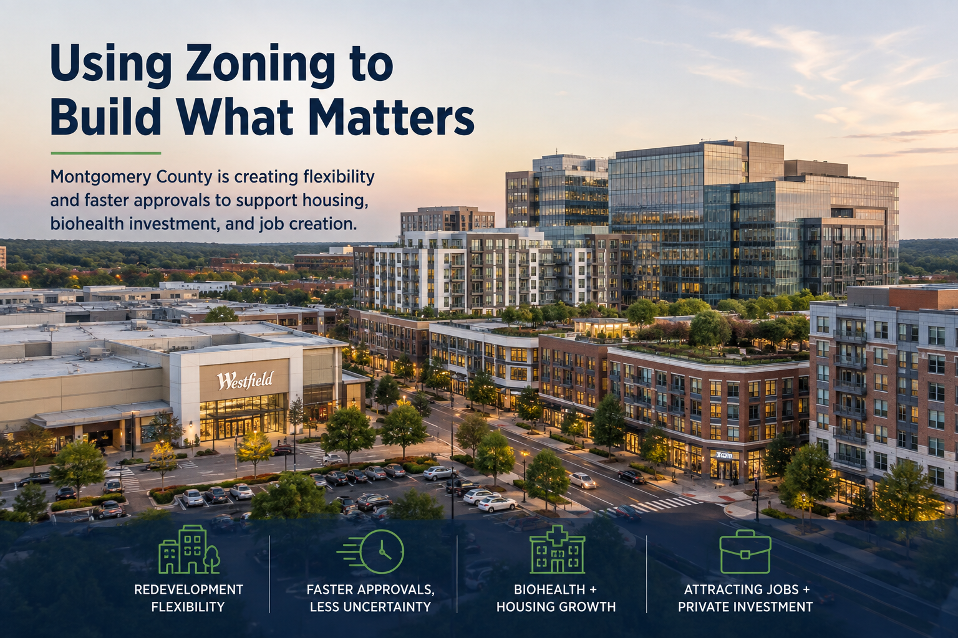
In March, the County enacted ZTA 26-02, which gives properties within the Regional Shopping Center Overlay Zone more flexibility to add housing. Normally, household living uses are limited to 30 percent of the gross floor area on these sites. The amendment allows residential development to exceed that limit as long as a regional shopping center containing at least 600,000 square feet is retained. The County described the change as a way to provide more flexibility in site design while maintaining a major commercial center.
Source: Montgomery County Council — ZTA 26-02
It's an interesting approach to a question that communities throughout the region are facing: How do you allow a place to evolve without requiring it to stop being what it already is?
The Mall Isn't Dead. It May Just Need Some Neighbors.
Reports of the mall's death may be slightly exaggerated. Large shopping centers still serve an important retail role. But from a planning perspective, many of these properties also have something that's increasingly difficult to find in developed parts of the region: a lot of land.
That changes the question. Instead of choosing between keeping the shopping center and redeveloping the property, could you do both? Housing and other uses can potentially become part of a site while the shopping center continues to operate. In Montgomery County's case, the zoning change is essentially saying: the shopping center can stay. It just doesn't necessarily have to live alone. That idea could become increasingly relevant as malls and other large retail properties throughout the Washington region consider what comes next.
“The shopping center can stay. It just doesn't necessarily have to live alone.”
Sometimes the Incentive Is Time
Two other amendments take a different approach. Rather than changing how much can be built, they change who can qualify for a faster approval process. The Council unanimously enacted ZTA 26-03 and ZTA 26-04 on March 17. Together, the amendments expand eligibility for expedited review for certain biohealth and mixed-income housing projects.
Source: Montgomery County Council — Accelerate MoCo
For biohealth projects, ZTA 26-03 lowers the minimum amount of new construction needed to qualify as a Biohealth Priority Campus from 150,000 to 100,000 square feet. It also reduces the threshold for additions and allows certain projects involving the reuse of existing office buildings to qualify. The connection to economic development is fairly direct. The Biohealth Priority Campus designation was created to help grow the County's biohealth sector, and the new amendment makes the expedited process available to a wider range of projects. ZTA 26-04 does something similar for mixed-income housing. It eliminates the previous 150,000-square-foot minimum and expands eligibility to projects using four-percent Low-Income Housing Tax Credits.
Source: Montgomery County Council — ZTA 26-03 and ZTA 26-04
The details are different, but the underlying idea is fairly simple: Time itself can be a development incentive. Montgomery County says its expedited process can reduce approval timelines by approximately 75 percent. For a project carrying land, financing, design, and other costs while waiting for approvals, that can be meaningful. Instead of offering additional density or changing a use, the County is making the regulatory path faster for projects that advance particular policy goals.
Yes, Faster Permitting Is an Incentive
It may not sound as exciting as a tax incentive or additional development potential. But anyone who has worked on a project through a lengthy approval process knows that “we can get you through review faster” can be a pretty compelling offer. Time affects financing, leases, construction schedules, consultant costs, and ultimately whether a project still makes sense. A faster process doesn't make those pressures disappear, but it can reduce some of the uncertainty.
And in development review, boring can be valuable.
A shorter, more predictable timeline may not make for a great ribbon-cutting announcement, but it can make a meaningful difference to a project.
Applying the Same Idea to Job Creation
A newer proposal takes that idea one step further.
ZTA 26-05, the Job Creation Project amendment, would broaden an existing expedited approval process for large business projects. The current framework is aimed at a “Signature Business Headquarters.” The proposed amendment would replace that concept with a broader “Job Creation Project” category and significantly expand eligibility. Among the proposed changes, the employee threshold would drop from 20,000 employees to 200. A qualifying business would no longer have to make the property its headquarters or primary place of business, and eligibility would be tied to strategic industries identified in the County's economic development strategy.
Source: Montgomery County Council — ZTA 26-05
Qualifying projects would also receive a Planning Board hearing within 60 days after an application is accepted. The Council has been direct about the purpose: attracting employers, encouraging private investment, and creating jobs. Here again, the regulatory process itself becomes part of the incentive. For a company deciding where to invest, knowing how long the approval process is likely to take – and having some confidence in that timeline – can matter alongside more familiar considerations such as location, workforce, infrastructure, and cost.
WHAT THIS MEANS
What Does This Tell Us?
None of these amendments, by itself, fundamentally changes Montgomery County's land-use system. Taken together, though, they show how zoning can be used as more than a set of rules for individual properties.
For regional shopping centers, the County is creating more flexibility so large commercial sites can accommodate additional housing. For biohealth and mixed-income housing, it's expanding access to a faster approval process. And with the Job Creation Project proposal, it's considering using that same tool more directly to compete for employers and private investment. There is a common thread: make it easier – or faster – for certain types of development to move forward when they support broader County priorities. That's worth watching beyond Montgomery County.
Communities throughout the Washington region are dealing with many of the same issues: aging commercial properties, demand for housing, a changing office market, competition for employers, and the need to make better use of already-developed land. Zoning won't solve all of those challenges. But Montgomery County's recent actions show how the rules, and the process for navigating them, can be adjusted to support a larger planning and economic-development strategy. The question isn't only what does the zoning allow? It's also what does the zoning make easier to do, and why?
CLOSING SECTION
The Practical Next Step
For property owners, developers, and project teams, these changes are a reminder that zoning is not static. A change in the rules, or in the review process, can create opportunities that were not available under an earlier version of the code. Before making a major development decision, it can be worth checking not only what the zoning allows today, but what recent amendments may have changed.
SOURCES
- Montgomery County Council — ZTA 26-02: Overlay Zones - Regional Shopping Center
- Montgomery County Council — Accelerate MoCo
- Montgomery County Council — ZTA 26-03: Biohealth Priority Campus - Eligibility and ZTA 26-04: Mixed-Income Housing Community - Eligibility
- Montgomery County Council — ZTA 26-05: Expedited Approval Plan - Job Creation Project
- Montgomery County Council — 2026 Zoning Text Amendments
.avif)
.avif)